
Mugello
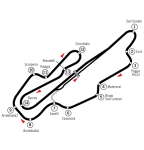
Nestled in the rolling hills of Tuscany, approximately 35 kilometers northeast of Florence, Autodromo Internazionale del Mugello stands as one of Italy's most challenging and visually stunning racing circuits. This 5.245-kilometer track has evolved from a modest motorsport venue into a world-class facility that has hosted some of the most prestigious racing series on the planet, including its memorable debut as a Formula 1 venue. The circuit's origins trace back to 1974 when it was first constructed as a 5-kilometer road course winding through the Tuscan countryside. Originally built with motorcycle racing in mind, Mugello quickly established itself as a favorite among two-wheeled competitors, becoming a permanent fixture on the MotoGP calendar where it hosts the Italian Grand Prix. The track's natural terrain and elevation changes made it an instant classic, challenging riders and drivers with its demanding layout that rewards precision and bravery in equal measure. Ferrari's influence on Mugello cannot be overstated, as the Maranello-based team purchased the circuit in 1988, transforming it into their primary test facility. Under Ferrari's ownership, the track underwent significant modernization and safety improvements while maintaining its essential character as one of Europe's most demanding circuits. The facility serves dual purposes as both a testing ground for Ferrari's Formula 1 operations and a venue for various racing championships throughout the motorsport calendar. The track's layout is a masterpiece of natural topography and thoughtful design, featuring a series of challenging corners that test every aspect of a driver's skill set. The main straight leads into San Donato, a heavy braking zone that often provides overtaking opportunities for those brave enough to attempt late moves. The circuit then flows through a series of medium and high-speed corners, including the challenging Luco and Poggio Secco sections, where precise car setup and driver commitment are essential for quick lap times. One of Mugello's most distinctive features is its dramatic elevation changes, with the track rising and falling through the Tuscan hills in a way that creates both spectacular viewing opportunities for spectators and unique challenges for competitors. The Casanova-Savelli section is particularly notable for its sweeping nature and elevation change, requiring drivers to master both the racing line and the circuit's undulating surface. The track's surface characteristics have evolved over the years, with modern safety requirements necessitating updates while preserving the challenging nature that makes Mugello special. The Arrabbiata corners, a pair of linked turns in the circuit's middle section, represent some of the most technically demanding parts of the lap. These corners require precise entry speeds and commitment through the apex, as small mistakes can result in significant time loss or, worse, contact with the barriers that line much of the circuit. The final sector includes the demanding Bucine corner and the flat-out approach to the main straight, where slipstreaming becomes crucial for overtaking attempts. Mugello made motorsport history when it hosted its first Formula 1 Grand Prix in 2020, stepping in as the venue for the Tuscan Grand Prix during the COVID-19-affected season. This race proved to be one of the most dramatic of that championship year, featuring multiple safety car periods and providing Ferrari with the emotional opportunity to compete in Formula 1 at their home circuit. Lewis Hamilton's commanding victory established the current lap record of 1:18.833, a time that showcases the pace required to master this challenging venue over the race distance of 59 laps. The circuit's reputation extends far beyond its single Formula 1 appearance, however. Mugello has hosted numerous other significant motorsport events, including rounds of the World Superbike Championship, various GT racing series, and continuing its long-standing relationship with motorcycle racing through MotoGP. The track's technical demands make it a favorite among professional drivers and riders, who often cite its combination of high-speed sections and technical corners as providing the perfect testing ground for both machine and human performance. What makes Mugello truly special is its ability to maintain the character of a classic European circuit while meeting modern safety and infrastructure standards. The facility features state-of-the-art paddock facilities, medical centers, and media infrastructure, all set against the backdrop of one of Italy's most beautiful regions. The viewing areas around the circuit take advantage of the natural elevation changes, providing spectators with commanding views of multiple corners and the surrounding Tuscan landscape. Current operations at Mugello continue to center around its role as Ferrari's primary test facility, where the team develops and refines their Formula 1 cars throughout the season. The track also maintains an active schedule of racing events, corporate hospitality functions, and driving experiences that allow enthusiasts to experience this legendary circuit firsthand. Its status as both a working test facility and a race venue ensures that Mugello remains at the forefront of motorsport technology and competition. The circuit's legacy is built on its reputation as a pure driver's track, where natural talent, technical skill, and intimate knowledge of the circuit's demands separate the great competitors from the merely good. Whether hosting the drama of MotoGP competition or the precision of Formula 1 testing, Mugello continues to embody the best traditions of European motorsport while adapting to the evolving needs of modern racing. This combination of heritage, challenge, and natural beauty ensures that Autodromo Internazionale del Mugello will remain a jewel in the crown of world motorsport for generations to come.