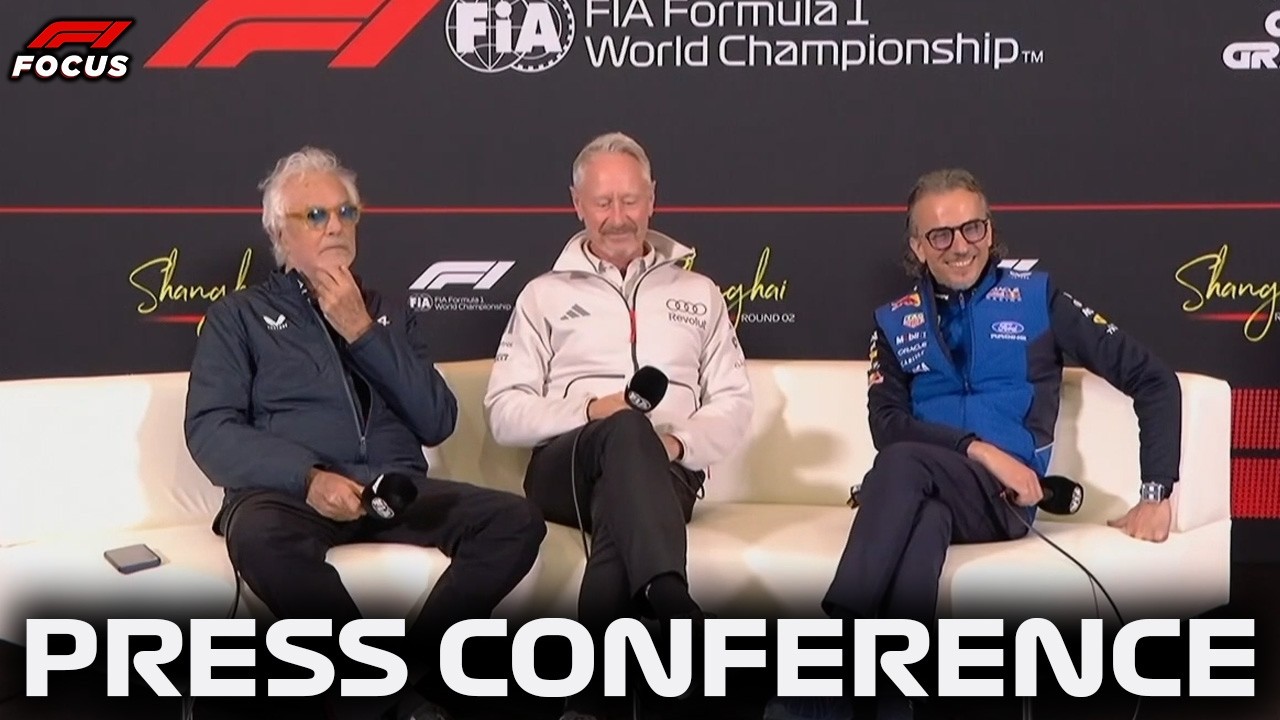
By the time Audi's leadership announced Jonathan Wheatley's departure with immediate effect, his last serious public statement on the project was already doing more work than the team's official press release. The pre-China briefing, given outside Shanghai's media centre, did not read like a man preparing to leave. It read like a calm, slightly resigned audit of a structural problem - and that audit is now the inheritance any successor will have to face.
The most quoted line was an arithmetical one. Asked whether Audi could be expected to close the gap to the Mercedes works team, Wheatley reached for a piece of mathematics that has since been adopted as the project's quiet shorthand.
"As a PU manufacturer, we only have two cars with an Audi PU in them, and Mercedes have eight cars. They're learning at a much faster rate as well. So we're not underestimating the challenge we have ahead of us."
The number is the part that matters. Mercedes power three customer teams alongside its own works programme - McLaren, Williams and Aston Martin - which gives the Brackley engine programme four times the on-track sample size that Audi has between Hulkenberg and Bortoletto. Under the 2026 regulations, where energy harvesting strategy and deployment behaviour is doing more lap-time work than combustion, that data delta compounds week-on-week.
Wheatley refused to spin around it. In a separate exchange, he identified powertrain development as Audi's main 2026 priority in language that read like a deliberate signal to the rest of the paddock.
"It won't come as a surprise to anyone. It's a brand new chassis, brand new power unit. We've got some areas to make up, and especially our focus at the moment is on the powertrain development. That's clearly one of the areas that we've identified."
The ordering matters. Wheatley was not telling the paddock that the chassis side of the team was finished and that the engine side was lagging. He was admitting that the two sides of the project were on different timelines, and that Audi's development resource would, for the foreseeable future, be skewed toward Neuburg's engine programme rather than Hinwil's chassis department. That priority has held in the way Audi have spent their development tokens since.

There was a deliberately upbeat passage about Gabriel Bortoletto. Wheatley was clear that the Brazilian rookie was the part of the project Audi most wanted to advertise, and that his early-season form had given the team a basis for genuine optimism about the long term.
"I've been encouraged with both drivers over the winter, recharging, coming back fully focused and absolutely embedded with their engineers, looking at every single area where you can get performance out of the team and out of the car."
That is the cultural piece of the inheritance. Audi's plan was always to use the early years of the regulation cycle, when the maths on engine sample size was always going to be against them, to build a long-term anchor in their own driver line-up. Hulkenberg's experience was supposed to stabilise the operation; Bortoletto's development was supposed to be the asset that paid out in 2027 and beyond. Wheatley's departure does not change that calculation. It does, however, hand his successor the choice of either continuing it or reopening it.
The team principal shortlist that emerged after his exit - Christian Horner, Andreas Seidl, Guenther Steiner, with Allan McNish moving in as racing director - tells you Audi understood the gravity of the replacement. Each of those names brings a different chassis-versus-engine philosophy. Each would handle the Bortoletto question slightly differently. Each would pace the gap-closing exercise on a different timeline.
What none of them can do is escape the structural maths. Eight Mercedes-powered cars on a 2026 grid, learning the regulation in real time, is not a number a single team principal can change. The project's only response is the one Wheatley laid out: target powertrain development, keep the chassis programme honest, build around the long-term driver, and accept that the first year will produce a result that does not flatter the brand.
The Drive Thru Penalty podcast was sharper about the manner of his exit, with one host suggesting the 'personal reasons' framing was code for a richer offer elsewhere. Whether or not that proves true, Wheatley's last serious Audi work is the cleanest structural read of the team's situation that the project has produced in 2026. It will outlast him.