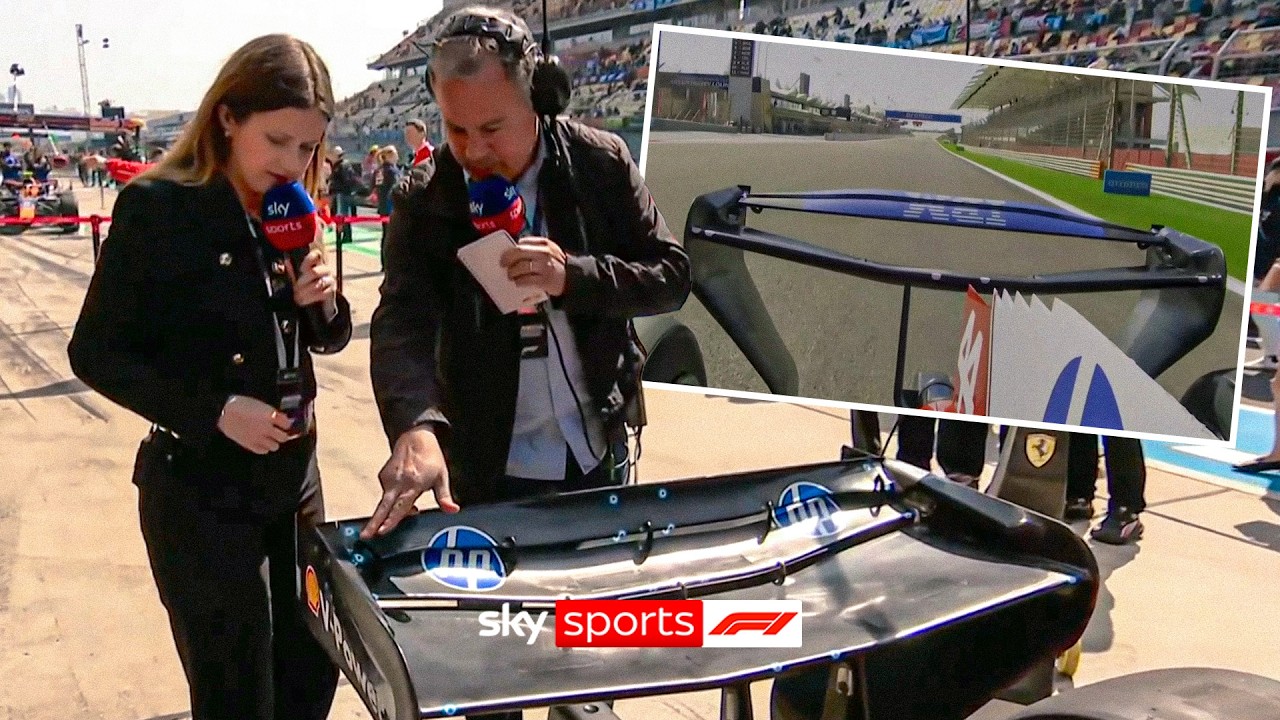
Ferrari has arrived at the opening rounds of the 2026 season with a rear wing that is already being called one of the most aggressive aerodynamic interpretations of the new active-aero regulations — and Sky F1's Bernie Collins has now walked through exactly what makes it different, how much lap time it should unlock, and why the rest of the grid has so far declined to copy it.
Nicknamed the "Macarena wing" because of its signature flipping motion, the device discards the conventional DRS-style flap actuator entirely. Instead, Ferrari's rear wing rotates 180 degrees on the straights, presenting an effectively inverted surface to dump downforce before rotating back for corner loads. The 2026 rules give teams significant latitude in how they shed rear drag on the straight, and Ferrari has taken that latitude further than anyone.
Collins, appearing alongside Ted Kravitz in Sky's technical breakdown, explained the giveaway visual cue to watch for on the Scuderia's car. "The easiest way to identify it is it doesn't have that actuator," she said, pointing out the absence of the familiar DRS-style pod between the rear wing endplates. "And then obviously it's got this very distinctive movement on the straight, where the entire wing flips 180 degrees over. They reckon that's going to gain them around 5kph at the end of the straight. So it's actually [a] significant gain compared to the normal sort of DRS-type wing."
Five kilometres per hour at the end of a straight is a genuinely meaningful advantage in 2026's reshuffled hierarchy. It translates into corner-entry speed for the following car, tenths of a second over a lap on power circuits, and a real overtaking tool on the brakes.
Collins was also disarmingly candid about the psychological dimension of the design. "I think they're trolling Red Bull next door," she joked. "They're really getting their hopes up on it."
On the all-important question of legality, she was unequivocal. The Macarena wing passed FIA scrutineering during pre-season testing and sits comfortably inside the 2026 active aerodynamics rulebook. "It's completely legal," she said. "They tested it during the Bahrain test, as we know. There's a few question marks over the reliability of it. That's why some other teams, I believe, haven't gone down that route."
That reliability question is where Ferrari's gamble gets interesting. Repeatedly rotating an entire rear wing assembly by a full 180 degrees at high speed — lap after lap, stint after stint — places enormous cyclic loading on the pivot mechanism. A traditional DRS flap barely moves by comparison. Any failure at speed would be serious.

That risk profile is almost certainly why Mercedes, Red Bull and McLaren have held back from cloning the concept. Ferrari, dealing with a combustion deficit of several tenths to Mercedes, has calculated that the straight-line reward is worth the engineering exposure. If the Macarena holds together, Ferrari has a weapon the rest of the field does not — and Bernie Collins's breakdown helps make clear exactly how it is meant to work.