
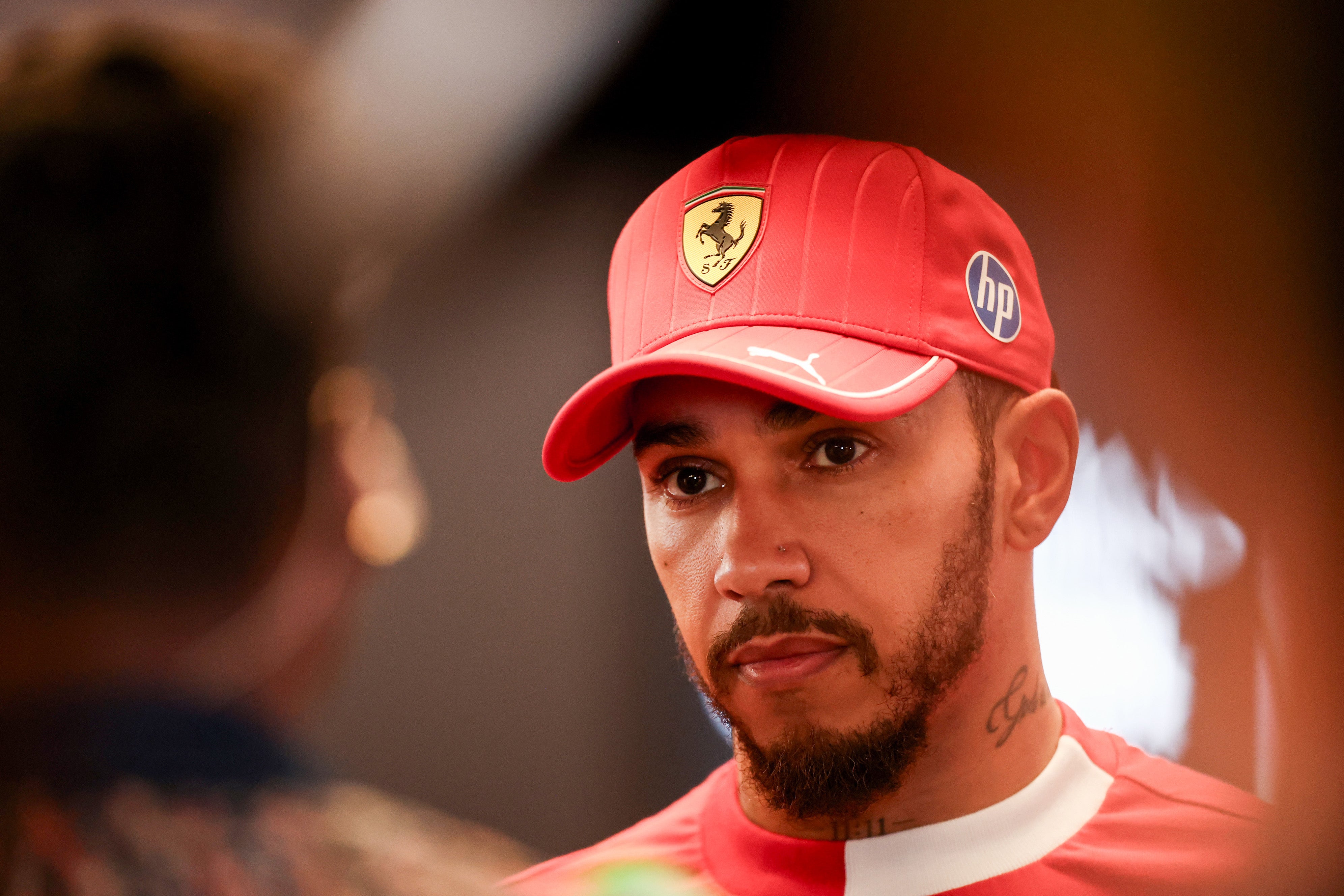
There are two pieces of Lewis Hamilton's race-week routine that the seven-time world champion has just deliberately broken. The first is preparing in Ferrari's simulator. The second is going quiet about why.
Hamilton walked into the Canadian Grand Prix week without logging a single lap on Maranello's rig — a decision that, according to a Slipstream Stories report citing Ferrari's internal debrief, followed three separate complaints he made about the SF26 in the days after Miami.
The first complaint was the simulator itself. Hamilton's view, per the report, is that the virtual SF26 has stopped behaving like the real one: every Friday he arrives in the pit lane chasing balance from the wrong starting point, while Charles Leclerc — whose natural style sits closer to whatever the rig is modelling — settles in faster.
The second was aerodynamic. Hamilton told engineers Ferrari's front wing visually does not look like the wings being run at the sharp end by Mercedes and McLaren. The third was hybrid: the SF26's energy deployment, by his account, is cutting battery power early enough on the straights to cost him three to four tenths before the brake pedal is even involved.
The context is brutal for Maranello. Ferrari brought eleven new parts to Miami — the biggest single push by any 2026 team. Chassis balance improved. Leclerc was quick through the slow corners of the Miami International Autodrome. None of that helped on the long runs, where Mercedes consistently pulled three tenths back on a single straight. The better the chassis got, the more obvious the power gap became, and the louder Hamilton's frustration grew.
His sim boycott has logic behind it. Hamilton's strongest 2026 weekend, the podium at the Chinese Grand Prix in April, followed a build-up in which he did not touch the rig. His weakest qualifying performances have arrived after the heaviest sim weeks. He has, on his own evidence, joined those dots.
The damage is wider than a single driver's Friday. Every aerodynamic change Ferrari designs gets validated in the simulator before it touches the car. If Hamilton is right that the virtual SF26 no longer mirrors what is on the truck, the eleven Miami parts were judged against a false baseline — and any further package brought to Montreal will be too.

Mercedes do not need Ferrari's internal problems to compound. Slipstream Stories also reports that the W17 will arrive in Canada with a three-tenth update of its own. Circuit Gilles Villeneuve is dominated by long straights and heavy braking zones, exactly the territory where Ferrari's power deficit was at its worst in Miami.
The Hamilton storyline going into Montreal is therefore less about race pace and more about trust. He no longer trusts the simulator. He no longer trusts the upgrade roadmap built on top of it. Whether Ferrari can rebuild either before the Canadian Grand Prix weekend begins is now the only question that matters.