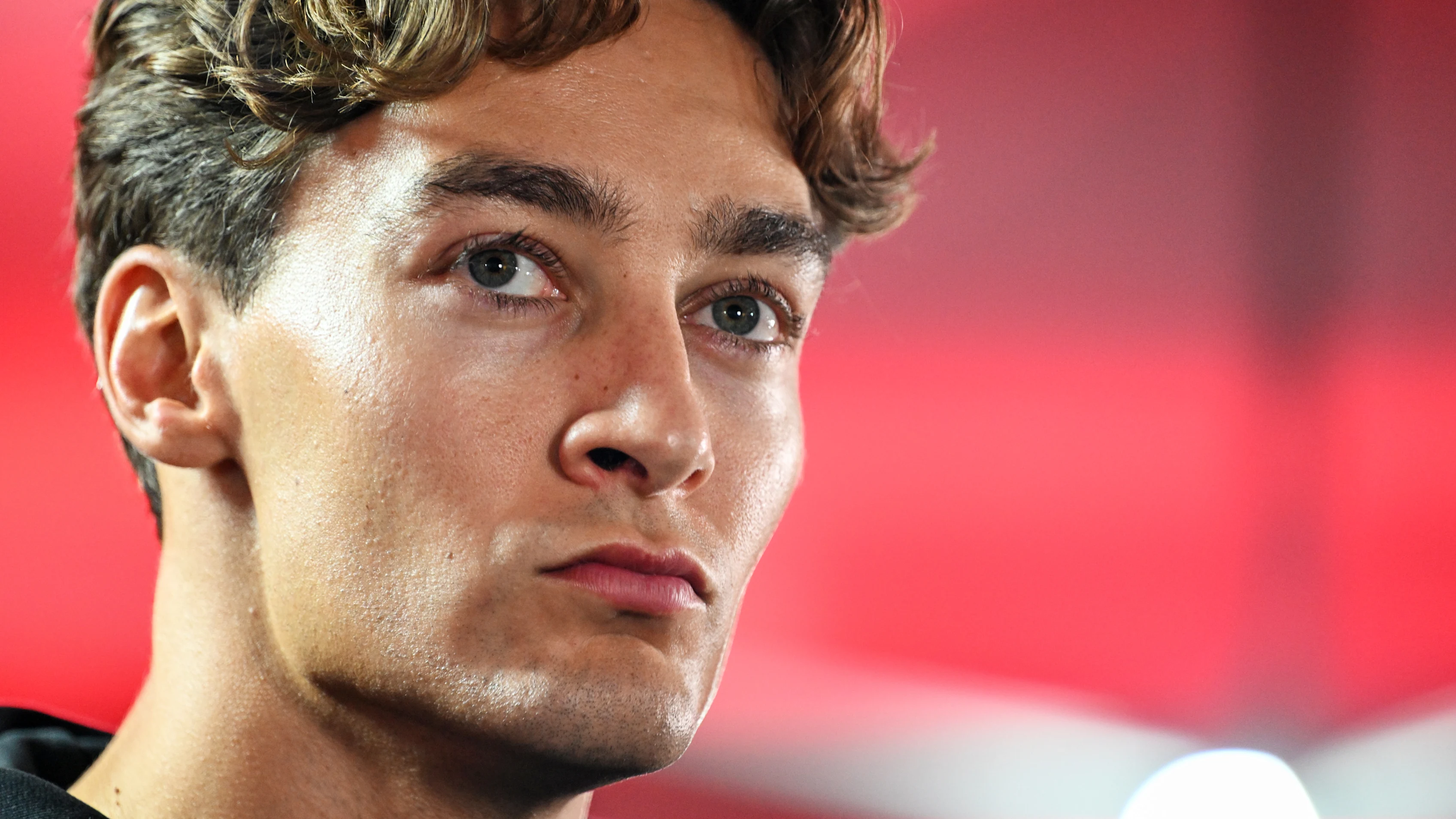
For most of 2026, George Russell's struggles have looked like a run of rotten luck. He led in Canada before a battery failure ended his afternoon. A safety car robbed him in Japan. At Monaco, a garbled Mercedes radio call left a pit-lane penalty unserved, the drive-through that followed wiping out a probable podium. Add it up and Russell is 68 points adrift of his 19-year-old team-mate Kimi Antonelli. But Monaco suggested the deficit runs deeper than misfortune — the 2026 Mercedes seems built for how Antonelli drives, not how Russell does.
Russell did not dodge it afterwards. He spoke of "something in my driving style" that is currently working against the car while "playing into Antonelli's hands," and noted that the contrast in how the pair attack a lap "has such an impact on the tyres." A year ago he was usually the faster Mercedes; now he is openly trying to diagnose why that has flipped.
The Race's Mark Hughes spelt out the mechanics. Russell is a high-commitment, smooth operator — brake early, settle the car, then carry serious speed through the corner. It was a winning recipe in the ground-effect era, and Hughes insists "economy and smoothness should not be mistaken for conservatism." But the 2026 cars run less downforce and slide more, demanding constant management of small, fidgety movements. The Race's analysis has Russell leaning too hard on the rear tyres at turn-in, failing to switch the fronts on, and cooking the rears over a lap.
Hughes reached for an awkward parallel, saying Russell has "a touch of the Oscar Piastri about him" — a nod to the low-grip weakness that helped unravel Piastri's 2025 title bid. Antonelli is the opposite fit: aggressive on paper, but with inputs that are small, constant and precise, perfect for a car that never stops moving underneath you.
That technical story feeds straight into Mercedes' biggest strategic call — whether to pursue Max Verstappen for 2027. Peter Windsor thinks the logic has shifted. "If you've got Kimi Antonelli, more importantly, why do you need Max Verstappen?" he asked. "Because Kimi can basically do the job that Max can do in that car." His counsel to Toto Wolff was direct: "If I was Toto Wolff I wouldn't touch too much of what he's got at the moment." Windsor sees a tidy, points-rich line-up — a future champion out front, a reliable wingman behind — and reckons bolting Verstappen alongside Antonelli would only invite collisions. "They won't be mates at the end of that year, I can tell you that," he said.
He left room for the other view. Verstappen, Windsor allowed, might actively want the fight, and as a neutral he would happily watch it: "bring it on." The split comes down to risk tolerance — protect a machine that keeps scoring, or roll the dice on the grid's best driver and the chaos that travels with him.
Russell's own answer is more immediate. Barcelona, a track that exposes any car unkind to its tyres, is next on the calendar, and it should reveal whether Monaco was an outlier or a warning.