
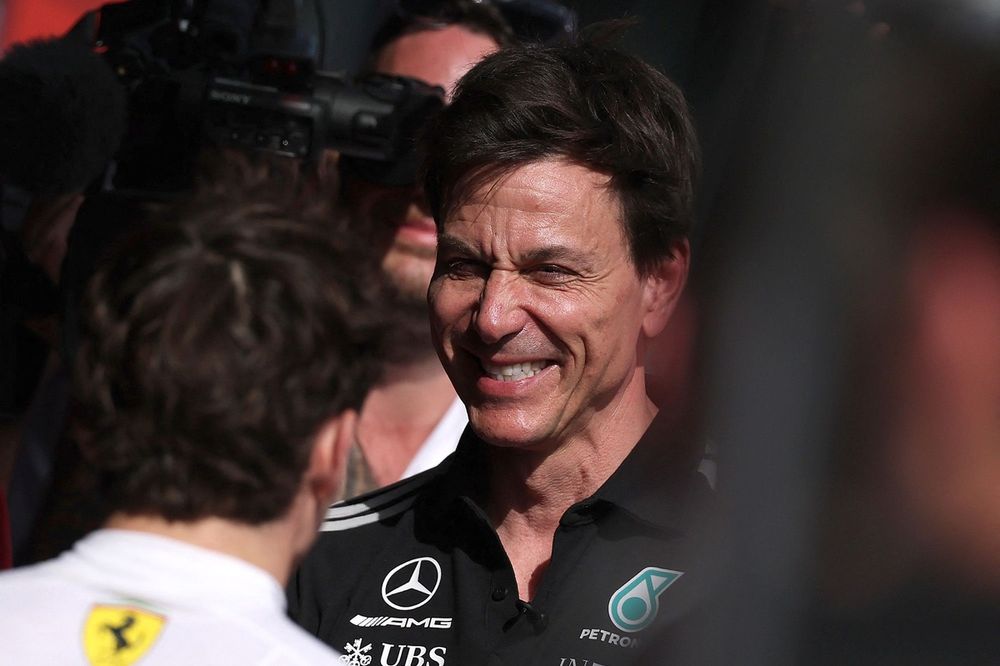
Toto Wolff was the first Mercedes voice to speak on camera after the inaugural Canadian Grand Prix sprint. He could have led with a team-line message about discipline and points. He led with this instead.
"It was great cinema, no?" Wolff said, sitting in the post-race interview booth. "Tough fighting, not only between our two, but also with Lando and further back. Enjoyed watching it."
The cinema he was talking about: George Russell defending the lead into Turn 1 on lap seven, Andrea Kimi Antonelli going for the outside and being run wide, then Antonelli lunging again into the next chicane, running across the marbles, and losing P2 to McLaren's Lando Norris.
For Mercedes, that swap of positions is the figure Wolff cannot wave away.
"I think you can see how quickly it goes," he said. "You create a gap with two cars and then you start to fight a bit, and you can lose a race. If that goes longer and a bit unlucky for us, and it's the Grand Prix, Norris may well win."
Wolff had cut in on Antonelli's radio mid-race to tell him to stop complaining about his own teammate's defence. Asked whether the message had been a one-off or part of something deliberate, his answer was the second of the two.
"You know, we don't want to start with race five and have headlines like 'Star Wars' or 'this is escalating', because it's not," Wolff said. "It's in the emotion, and he's a young driver, and I think George would have probably done the same. So we just need to see how we handle it."

The phrase Wolff kept coming back to was "framework". The point of the radio call, in his telling, was not to single Antonelli out. It was to establish a way Mercedes would expect both drivers to operate from here.
"I really enjoyed these moments because it allows us to learn and to say, 'OK, what are we doing with this situation? How are we handling that in the future?'" Wolff said. "Because you don't want to lose a race, you don't want to crash into each other. And sometimes it needs a little moment to remind ourselves what our objectives are. This is not particularly against one or the other, but there's a framework that we want to establish, and I'd rather have it in a sprint race where it's not about a lot of points than in the main race."
Whether the framework holds will be tested almost immediately. Russell put a Mercedes on pole for Sunday's Canadian Grand Prix later on Saturday afternoon, with Antonelli alongside him on the front row again — 0.068 seconds slower, the exact same gap as in sprint qualifying. Antonelli still leads the championship by 18 points.
Two Mercedes on the front row. Both wanting to win the race. Both told by their team principal, in effect, that the fight is theirs to manage.
If Sunday turns wet — and the forecast says it will — the first laps into Turn 1 may be more revealing than the Wolff debrief. The framework is set. The race is the audit.