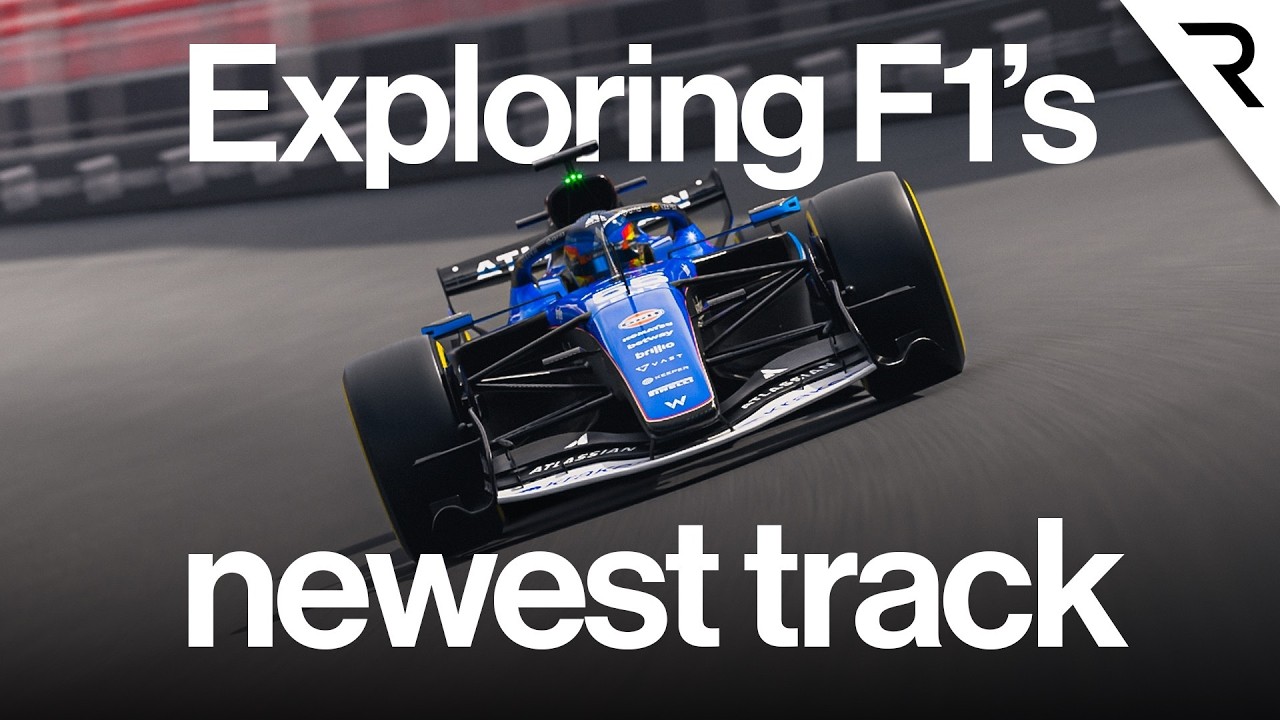
Three months before Formula 1 races there for the first time, Madrid's Madring is still wrapped in scaffolding and earth-movers — and the paddock has already started arguing about it. Media made the short hop from the Barcelona-Catalunya Grand Prix to tour the 5.4km, 22-corner circuit on the city's IFEMA exhibition grounds, which inherits the Spanish Grand Prix on 13 September. The thing they came to weigh up: that vast banked corner the whole place is built around.
La Monumental is the headline. Roughly 550 metres long, it is described as the longest corner in Formula 1, banked at a maximum 24% — about 13.5 degrees — and cars are tipped to spend close to six seconds within it. Get it right and Madrid has an instant landmark. Get it wrong and it is an expensive curiosity.
The Race's Ed Straw put the doubt bluntly from trackside: "Is the Bank Monumental Corner going to be great or just a gimmick?" His colleague John Noble, seeing the layout in the flesh for the first time at the launch, was won over by the things simulations miss. "One of the core elements of a good racetrack has always been elevation," Noble said. "I was surprised here actually how much elevation there is. It's going to be a spectacular corner before it drops down into the back section."
Carlos Gimenez, the Madring's chief operations officer, is the man tasked with selling it. "This is special because not only of the inclination, also the length is extremely long," he told The Race. "Due to the huge inclination it could operate like a virtual length for the drivers. But it's also interesting to mention that the exit of the turn to reach the next one has blind spots. So it's going to challenge a lot the drivers." He added that the banking was raised from excavation soil dug elsewhere on the site, framed as a way to cut the carbon cost of carting material off the plot.
For Carlos Sainz, the project is personal. The Madrid-born Williams driver is the circuit's ambassador, and he expects La Monumental to bite. "I can already tell you it looks impressive because we're going to be entering that corner at a very high speed already, around I think 180 to 200 kph," Sainz said. "My feeling is a corner that is going to be flat out the whole way, and it's going to create an overtaking opportunity into the next left."
Whether it really will be flat — and whether flat is even desirable — is where the optimism frays. On The Race's podcast, Madrid-based journalist Diego Mia pointed to the contradictions: "Carlos was saying today that it could be flat out... but a few weeks before, when he did the lap in the Mustang, he wasn't saying it was going to be flat, and he obviously had to lift." History adds the caution. An easy flat-out corner can be forgettable — Eau Rouge was effectively flat for a generation of cars — and Valencia, F1's last bespoke Spanish street circuit, vanished from memory almost as soon as it arrived.
Paddock photographer Kym Illman, after hours on site, has fewer reservations about the deadline. "Is the Mad Ring going to be ready for the September race weekend? I say yes," he said, likening the corner's promise to "Spa's Eau Rouge or Silverstone's Maggots and Becketts." With grandstands wrapping the banking, he expects something "a bit like a stadium, a bit like a cauldron," and reckons the venue will eventually hold up to 140,000 a day and bring Madrid half a billion euros across the 10-year contract.

For now it is all projection. "It doesn't really come alive until an F1 car's on it," as Noble said. The first competitive verdict on La Monumental — and on a Spanish Grand Prix prised away from a Barcelona race now slipping to alternate years — lands on 13 September.