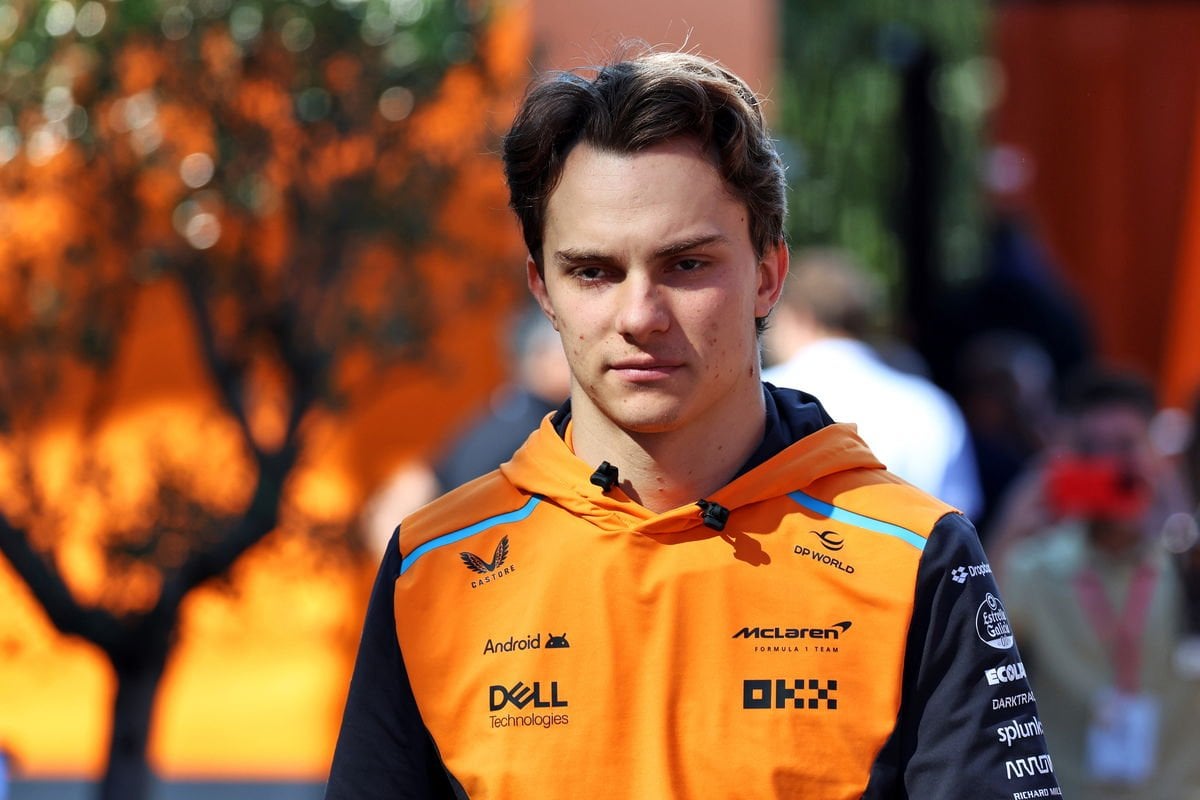
A week after the Hungarian Grand Prix, the five-second penalty handed to Carlos Sainz for tipping Oscar Piastri out of the lead is still generating argument - and increasingly the argument isn't about Sainz at all. It's about whether Formula 1's blue flag rules were ever calibrated correctly.
Piastri was trying to lap Sainz and Fernando Alonso when they collided, at a moment when the FIA's automatic blue flag light system had stopped working properly.
As written, the rules leave a backmarker very little room. The FIA's International Sporting Code obliges a lapped driver to yield at "the first available opportunity". A pre-warning reaches the team at three seconds; blue light panels appear at 1.2 seconds, along with cockpit lights on the steering wheel - the part that failed in Budapest. Translated to the track, "first available opportunity" works out at roughly three marshal posts.
Conor Daly, whose IndyCar background involves lapped cars actively defending to stay on the lead lap, told The Race F1 Podcast that F1 has tilted the balance too far without ever being able to scrap the concept outright.
"I don't think you can eliminate it, but I do think that you can't expect everyone to give up," Daly said. "You can't eliminate the blue flags because you do want to see the best battle possible for the win. But you can't expect people to not want to race."
He conceded the view flips depending on where you're sitting. "I can't picture racing without [blue flags] because certainly if I'm in the lead, I don't want to have to deal with any of that. I don't want to have to deal with any lapped traffic. I want them to get out of the way as soon as possible."
What Daly wants is a slower trigger, not an abolition. "I do think that three marshals posts can come by very fast. [Maybe better if it's] 'hey, if you don't get by him in a lap, we're going to start getting very aggressive with this blue flag'." And if a leader still can't clear a backmarker in that window, he suggested the leader has other things to worry about: "If the leader can't get by in one lap within two seconds, I mean, the leader's got more problems than that."

Glenn Freeman of The Race pushed the criticism harder, casting the current wording as an overcorrection to years of complaints from the front runners.
"F1 has just maybe gone too far, like you have to get out of the way too quickly now," Freeman said. "Three blue flags... I wonder if that's a bit too much. But obviously, like most things in F1, it's become more prescribed because people complained about the way it was before."
He argued a genuine skill has been legislated out. "[Before] the blue flag was just kind of advising you that a faster car is behind. That's why some drivers became almost famous for being a bit rubbish at getting out of the way. There was an art form to making your way through traffic. Now there isn't really."
His summary of a backmarker's afternoon under the current rules is bleak: "You see a handful of blue flags, you basically have to give up, let the leader by. Then you've kind of got to hope that someone else in front of you has to give up to let the leader by so you can get back on with your race."
James Vowles doesn't accept the premise. The Williams team principal's complaint isn't that the rules ask too much, but that the machinery enforcing them broke and left drivers guessing about the running order of concessions. By his reading, Alonso - not Sainz - owed Piastri the position first.
"Fernando had a number of blue flashing lights all the way through and in fact remained in position in front of Oscar," Vowles said in a team video. "You have to do it in order, so Fernando should have conceded that position earlier. What happened is, he didn't."
Alonso's move on Sainz at turn one then reversed which car was technically behind, twice, within two corners. "What complicated it is fundamentally without the automatic system, cars were staying in place for perhaps longer than they should have done," Vowles said. "Second to that, you have to know which one is exactly the car behind at the right moment."
Williams's own error, he admitted, was one of timing on the radio. "What we did do is communicate to Carlos into turn one that Oscar was coming. What we should have done, because ultimately we're still racing for a non-point scoring position, is indicate to Carlos that that was happening at the point where he was alongside Fernando on the run down to turn two. So that's what I mean by it's our culpability. But it wasn't an attempt to go and block Oscar."
His request to the governing body is about contingency rather than philosophy: "We need to make sure that as FIA systems do fail - and they will fail from time to time - we have a slightly better mechanism in place."
The stewards never examined Alonso's blue flag response, and left the signalling failure out of their reasoning entirely, though Sainz's limited view of Piastri counted as mitigation. A rule applied strictly to one driver while the system meant to identify who should move had stopped working - that mismatch is what has kept the debate alive through the summer break.