The build-up to next week's Austrian Grand Prix has been overshadowed by an argument about engines — and the strange position of a team protesting that it has been judged too good.
Formula 1's new Additional Development and Upgrade Opportunities (ADUO) framework ranks the 2026 combustion engines from strongest to weakest: Red Bull first, then Mercedes, Ferrari, Audi and Honda. The measurement covers only the internal combustion unit, leaving out the electrical side that accounts for almost half of a power unit's total output. Because Red Bull's in-house engine — its first, built with Ford — set the benchmark, the team is allowed no upgrades at all. Mercedes, placed more than two percent back, may take one this season; Ferrari, Audi and Honda, more than four percent adrift, get two apiece.
The optics are odd. Mercedes have won six of seven grands prix so far, but it is Red Bull that has been crowned with the "best engine" tag and denied the chance to develop. Max Verstappen admitted in Barcelona that he was "surprised" to find his team on top of the list.
Red Bull principal Laurent Mekies accepts the rule while rejecting the conclusion. "We are completely with the fact that the rule states that you should only try to estimate the pecking order of the ICE power," he told Sky Sports F1. "We are completely okay with that; we have all agreed to that, and we don't think that is the issue. Where we certainly would like to have a deeper conversation is because we do not see one single data sample that indicates that we would have an advantage over our friends at Mercedes."
He said Red Bull had "opened a very good dialogue" with the FIA, and doubts the reading can be trusted. "It's actually a very difficult measurement to make. We have one sensor in the car that tries to measure that, that has a number of limitations," Mekies said.
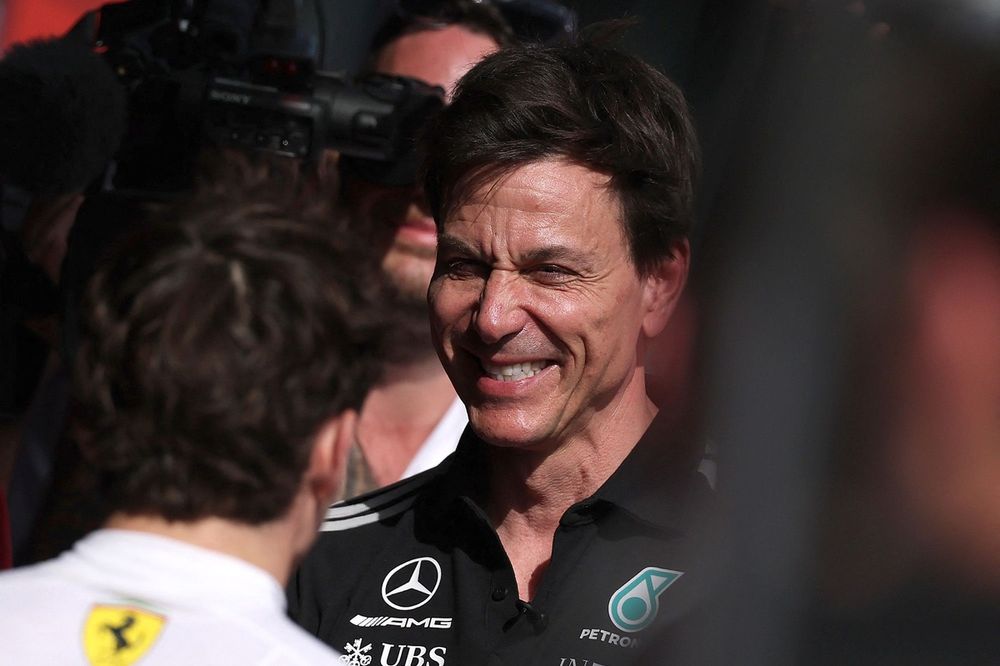
Toto Wolff, who stands to gain, sees no controversy in the figures. "It's data that they have measured and collected," he told Sky. "There's no political background, there is no favours, but it's the outcome of their analysis of their torque sensors and the way it's being done, and that is the result."
The Mercedes boss is far less relaxed about the idea of a Balance of Performance, the equalisation system common in sportscars. "I get a rash of allergy when talking about BoP," he said. "This is something that we should stay far away from Formula 1. It's a political mess in all the other series. It makes manufacturers go out of the sport, also, and I've been very close to that, as you can imagine, in DTM, in GTs, in Le Mans."

Wolff cast ADUO as insurance against another period of single-team dominance — the sort Mercedes once enjoyed, taking 51 wins from 59 races between 2014 and 2016. "It was [intended to be] a protection mechanism to avoid the 2014 situation," he said. "We were on the good end of that."
Others would rather reshape the mechanism than defend it. Audi CEO Mattia Binotto floated linking engine development to the championship order, as already happens with wind tunnel time. "If you are behind in the standings, you've got more opportunity in wind tunnel timing, etcetera, and that's a way for teams somehow to converge," he said.
With the FIA still to confirm the rankings and two more reviews scheduled after Hungary and Mexico City to set the 2027 picture, the dispute is far from settled. The only point of consensus in the paddock is that quantifying an engine is harder than quarrelling over one.