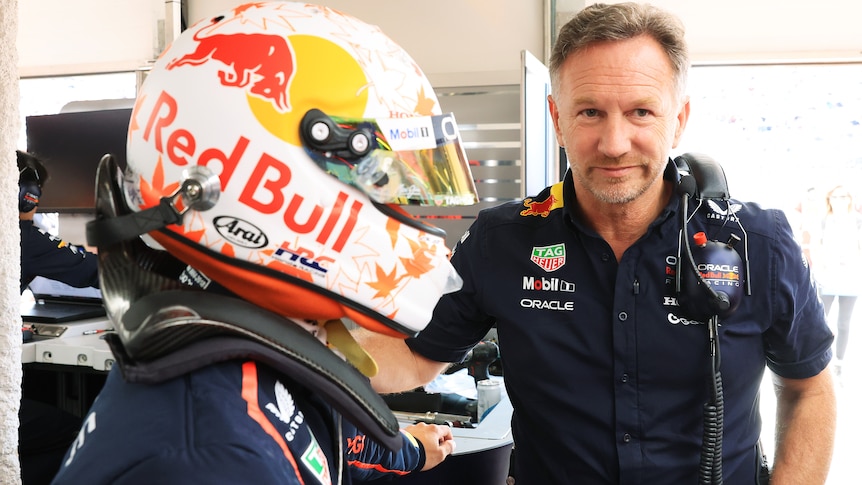
For ten months, Christian Horner has been one of the most-watched people in motorsport without actually working in it. Sacked by Red Bull in July 2025 after twenty years and six constructors' titles, the question was never whether he would return to F1 but in what role and with whose money. This week, both halves of the question came into focus.
The role is team principal of a new entry. The money is BYD.
ESPN and the Financial Times both reported the existence of formal discussions in the lead-up to the Canadian Grand Prix. Speedcafe, racingnews365 and PlanetF1 have followed with corroborating detail. The pattern that emerges across the reports is consistent enough that the conclusion is no longer speculative.
The trail starts in March 2026. According to ESPN, BYD officials met F1 CEO Stefano Domenicali at the Chinese Grand Prix that month. That is the formal start of the F1 conversation. By mid-May, Horner himself was visible alongside BYD executive Stella Li at the Cannes Film Festival, in the days surrounding the Monaco E-Prix. By the Canadian Grand Prix week, the discussions were being briefed out as serious.
The timing is not coincidence. Horner's settlement terms with Red Bull, multiple reports have indicated, included a non-compete window that expired around this point in 2026. The Canadian Grand Prix is the first race window during which he could formally engage with another F1 entrant without breaching that agreement. The fact that BYD-aligned briefings have surfaced in exactly this week speaks to the level of preparation involved.
Horner's own line on his return has been deliberately uncompromising.
"I am not going to come back for just anything," he has said. "I am only going to come back for something that can win."

That single quote is the framework. Horner is not interested in joining a midfield entrant, taking a soft consultancy role at an existing manufacturer or attaching himself to an integration project of someone else's design. A BYD-funded operation – built around his own structural and recruitment vision – is the kind of project that meets the bar.
BYD has the resources. The Chinese EV giant is valued in the hundreds of billions of dollars and is one of the few companies on earth that could plausibly bankroll an F1 team from scratch while also leveraging the F1 platform for its own brand globalisation. With F1 currently expanding its commercial presence in Asia and the United States, a credible Chinese-backed entry has a strategic logic for both sides.
The complications remain real. ESPN's sources have explicitly cautioned that BYD is "a way off making any kind of commitment." The financial entry threshold for a 12th team is enormous: anti-dilution payments to existing teams, the cost of a new facility, recruitment of upwards of a thousand staff, and the building of an engine programme either in-house or via a customer deal. Cadillac's entry as the 11th team, while structurally easier, has taken years.
There is also the F1 governance question. The Cadillac deal was negotiated on the basis that F1 had the appetite for an 11th team but not necessarily a 12th. A serious BYD bid would force that question to be reopened.
All of which is to say: this is not a deal that gets signed in Montreal this weekend. But the architecture is now visible. Horner has the ambition, BYD has the capital, F1 has the slot. The Canadian Grand Prix is where the public conversation began. The question now is what gets agreed in the months that follow.
For now, the only certainty is the one Horner has stated himself. He is only coming back for something that can win. The BYD discussion suggests he believes such a project, finally, exists.